
Best Space Heater for a Home Office: What to Look for in a Compact Ceramic Heater
Find the best space heater for your home office. Compare ceramic, radiant, and oil heaters, understand desk safety clearances, and evaluate compact options.
Editorial Transparency & Affiliate Disclosure
Air Crafted Home may earn a commission when you purchase through links on this site, at no additional cost to you. Affiliate relationships do not automatically determine our editorial conclusions. Our recommendations are strictly supported by physical evidence, building-science standards (DOE, AHAM, EPA), and transparent evaluation criteria. Read full disclosure and evaluation methodology.
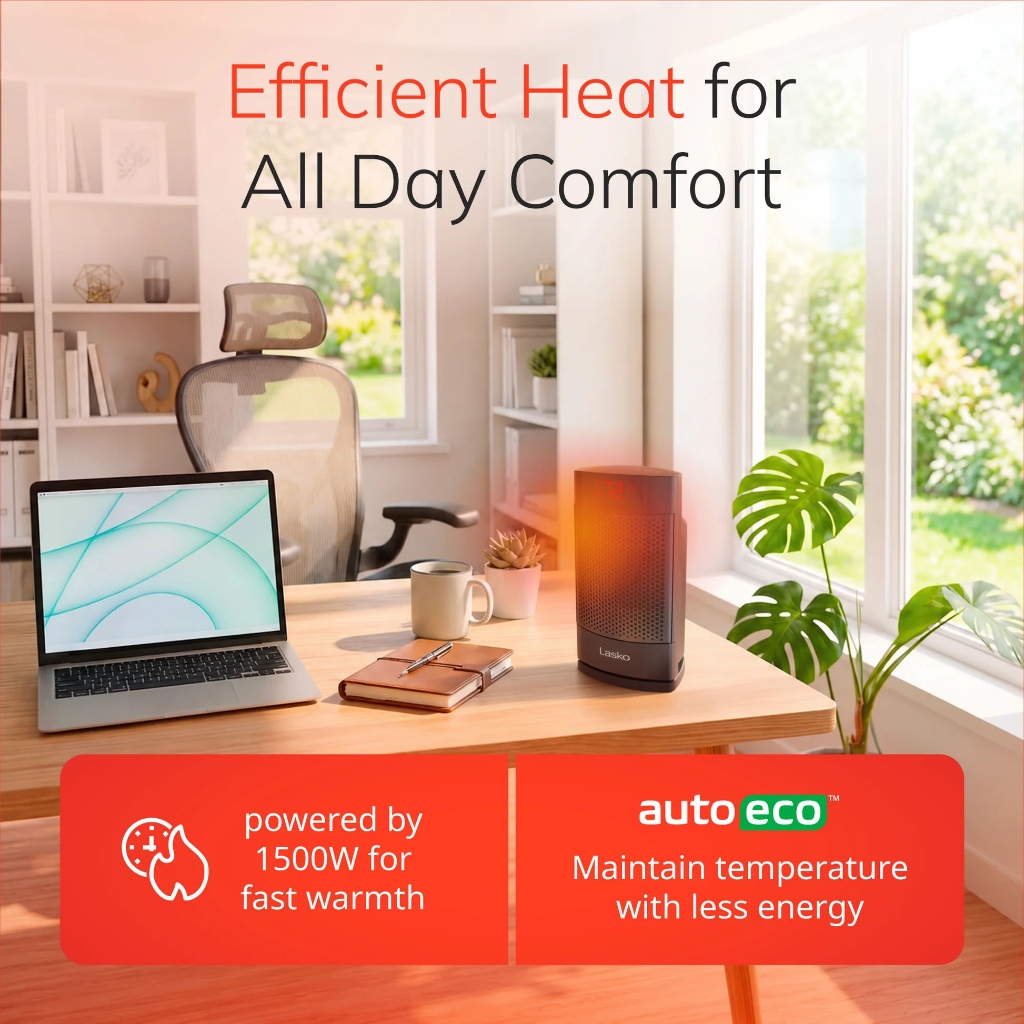
The best space heater for a home office is a compact, fan-assisted Positive Temperature Coefficient (PTC) ceramic heater featuring multiple heat settings (such as 750W Low and 1,500W High), widespread oscillation (90° to 120°), and an automatic electronic thermostat. Because home offices typically range from 100 to 200 square feet, a compact 12-inch ceramic tower heater provides targeted, rapid convective warmth within 60 seconds without consuming valuable desk or floor space. For desk setups, non-negotiable safety features include a physical tip-over microswitch, automatic overheat protection, cool-touch outer housing, and a dedicated 120V wall receptacle with at least 3 feet of clearance from combustible papers, drapery, and furniture per CPSC and NFPA guidelines. A compact unit like the Lasko Ellipse 12" (CD12950) illustrates these core criteria, offering 120° oscillation, 3 heat stages, and an integrated child lock for compact workspaces.
Core Takeaways
- •Rapid Convective Warmth: Ceramic PTC heating elements reach full thermal discharge within 60 seconds, making them substantially more responsive for home offices than slow-to-warm oil-filled radiators.
- •Oscillation Prevents Hotspots: 90° to 120° widespread oscillation gently circulates heated air across a seated work arc rather than blasting dry, high-density heat at a worker's legs.
- •The 3-Foot Safety Perimeter: Home offices are filled with combustible materials (paper, trash bins, curtains, upholstery); the CPSC and NFPA mandate keeping at least 3 feet of clearance around all heater surfaces.
- •Dedicated Circuit Requirement: A 1,500W space heater pulls 12.5 Amps on a standard 120V US circuit; it must never share a circuit with high-draw equipment like laser printers or gaming PCs, and must never be plugged into extension cords.
- •Price & Feature Verification: Compact ceramic heaters like the Lasko Ellipse (currently listed at $69.99 as supplied by the site owner) offer multi-stage wattage and child safety locks, but pricing and availability should always be confirmed on the official manufacturer listing.
Independent Technical Consensus & Sourcing Framework: This buying guide is synthesized from published safety standards by the US Consumer Product Safety Commission (CPSC) and the National Fire Protection Association (NFPA), electricity tariff data from the US Energy Information Administration (EIA), thermodynamic building envelope research from the US Department of Energy (DOE), and manufacturer nameplate specifications from Lasko Products, LLC. Air Crafted Home did not conduct physical destructive or acoustic chamber laboratory testing. We maintain editorial independence and do not accept paid product placements.
Comparative Performance Analysis
| Evaluation Criteria | Compact Ceramic Heater (e.g. Lasko Ellipse) | Oil-Filled Radiator or Quartz Radiant | Engineering Verdict |
|---|---|---|---|
| Heat-Up Time & Response | Rapid (convective warmth discharged within 45–60 seconds) | Slow for oil (15–30 min to warm); instantaneous for radiant line-of-sight | Ceramic (Fastest comfortable room warm-up) |
| Physical Footprint & Portability | Compact vertical profile (~12" tall, ~3–5 lbs); easy desk/floor placement | Heavy chassis (15–22 lbs for oil radiators); radiant requires wide clearance | Ceramic (Superior space-saving office fit) |
| Air Distribution & Oscillation | Fan-assisted with wide 90°–120° oscillation for even seated comfort | Passive convection (oil) or narrow direct beam (radiant); rarely oscillates | Ceramic (Balanced gentle airflow) |
| Operating Acoustics | Low, steady fan white noise (<40 dB on low/eco settings) | Silent operation (oil-filled) or slight metallic expansion clicks | Oil-Filled (Dead silent) / Ceramic (Quiet white noise) |
| Safety for Busy Desks | Cool-touch housing, internal tip-over switch, and child locks available | Hot metal radiator fins (surface burn hazard); radiant element glow | Ceramic (Lower exterior contact temperatures) |
| Typical Price Range | $45 – $85 for quality compact models ($69.99 for Lasko Ellipse) | $75 – $140 for quality sealed oil-filled radiators | Ceramic (More budget-accessible for remote workers) |
Introduction: The Home Office Climate Dilemma
For millions of Americans working remotely, winter introduces a frustrating heating dilemma. You sit in an enclosed bedroom, converted spare room, or basement office for eight hours a day, feeling chilly while typing at your desk. Yet turning up the central thermostat warms the entire 2,000-square-foot house—wasting costly natural gas, oil, or electricity on empty guest rooms, hallways, and living rooms just to warm a single desk chair.
This is where zone heating makes practical financial sense. By setting back your central heating and using a compact, energy-conscious space heater in your immediate workspace, you can maintain comfort where you actually sit without subsidizing heat for unoccupied square footage. In our detailed analysis on Space Heater vs. Central Heating, we demonstrated how a disciplined 7°F to 10°F central setback paired with a supplemental heater can reduce net household heating expenses.
However, choosing the best space heater for a home office is not as simple as picking the cheapest model off a store shelf. Home offices present distinct physical constraints: tight legroom beneath desks, piles of printer paper and cardboard boxes, delicate electronic equipment sharing branch circuits, and hours of continuous sedentary occupancy.
In this comprehensive buying guide, we break down what to look for in a compact ceramic heater, compare common heating technologies, review essential safety rules, examine real operating costs, and evaluate how an option like the Lasko Ellipse 12" Ceramic Space Heater fits into a modern home work environment.
Editorial Disclosure: This article contains affiliate links. If you purchase through them, Air Crafted Home may earn a referral commission at no additional cost to you. We maintain strict editorial independence and never accept paid placements.
What Makes a Space Heater Suitable for a Home Office?
A home office is not a drafty garage workshop or a sprawling living room. When shopping for a compact space heater for a desk area, your selection criteria should focus on five core factors:
1. Compact Physical Footprint and Vertical Form Factor
Home office floor space is valuable real estate. Bulky oil-filled radiators or wide baseboard heaters create tripping hazards and crowd computer towers, chair casters, and footrests. A compact vertical tower standing approximately 10 to 14 inches tall with a footprint under 7 inches square fits conveniently alongside a desk or on an unobstructed credenza.
2. Multi-Stage Wattage (Low vs. High Modes)
All residential 120V electric space heaters in the United States are capped by safety codes at a maximum draw of 1,500 Watts (5,118 BTU/h). However, running at continuous 1,500 Watts in a small, closed 120-square-foot office often causes rapid overheating. A suitable office heater must include lower wattage settings—such as Low (750W to 900W) or an AutoEco thermostat mode—allowing you to maintain steady warmth at lower electrical draw.
3. Widespread Oscillation vs. Static Directional Blasts
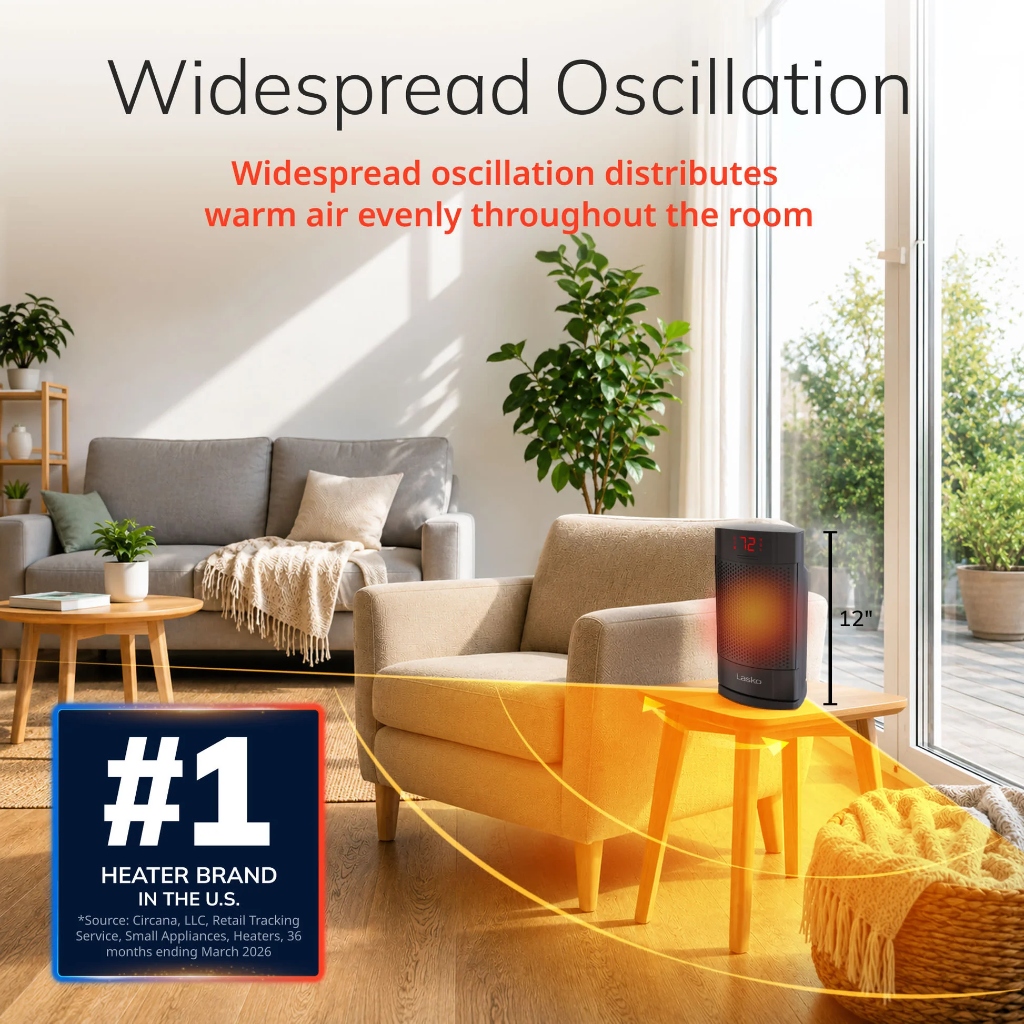
Static heaters blow a concentrated column of hot air in one fixed direction. If placed near your feet, a static heater can uncomfortably toast your shins while leaving your upper body chilled. A unit with 90° to 120° motorized oscillation circulates heated air across your seated workspace, creating a gentle thermal envelope rather than an intense hotspot.
4. Acoustic Profile for Phone Calls and Video Meetings
Remote workers spend hours on Zoom, Teams, and phone calls. While oil-filled radiators are completely silent, their slow warm-up time is a drawback. A quality ceramic heater uses a balanced internal blower fan that emits a soft, steady white noise (ideally under 40 to 45 decibels on low settings) that microphone noise-suppression algorithms easily filter out.
5. Independent Electrical Safety Protections
Home offices are densely packed with combustible items—stationery, filing cabinets, wastebaskets, and draperies. A heater for this environment must have an integrated tip-over microswitch that cuts power instantly if nudged by a foot or a pet, along with an automatic overheat thermal limiter and third-party certification (ETL or UL listing).
Compact ceramic models—such as the Lasko Ellipse 12" Ceramic Space Heater—are engineered precisely around this desk-side balance of small physical size, multi-stage heat, and integrated safety shut-offs.
Ceramic vs. Radiant vs. Oil-Filled: Which Heater Type Fits a Desk Setup?
Understanding the mechanical differences between heating technologies prevents buyer remorse. While all electric heaters convert electrical energy into heat at 100% efficiency (Joule heating), they distribute that heat into the room using fundamentally different physical mechanisms.
1. Ceramic PTC Heaters (Best Overall for Home Offices)
Ceramic heaters pass electrical current through conductive Positive Temperature Coefficient (PTC) ceramic stones. An internal fan draws cool room air across the heated ceramic elements, exhausting warm convective currents into the room.
- Advantages: Extremely rapid heat output (warm air discharges in 45 to 60 seconds); compact chassis; lightweight (3 to 6 lbs); supports motorized oscillation; ceramic stones self-regulate temperature as they warm up.
- Trade-offs: Emits a soft fan hum; does not retain heat once powered down.
- Office Verdict: The ideal choice for typical 100 to 200 sq ft home offices requiring fast, controllable warmth during the workday.
2. Quartz / Infrared Radiant Heaters
Radiant heaters use quartz tubes or carbon elements to emit infrared radiation that warms objects and people directly in their line of sight, rather than heating the surrounding air.
- Advantages: Instant line-of-sight heat; completely silent; highly effective in drafty spaces where air changes rapidly.
- Trade-offs: Only warms what is directly in front of the reflector grille; moves no air; can feel excessively intense on exposed skin; creates bright orange visual glare that can distract during computer work.
- Office Verdict: Useful for open uninsulated garages or cold warehouse desks, but generally too directional and intense for enclosed indoor offices.
3. Oil-Filled Radiator Heaters
Oil-filled radiators seal diathermic oil inside heavy metal fins, using an internal electric element to warm the oil, which slowly transfers heat to the room via natural passive convection.
- Advantages: 100% silent operation; zero fan drafts; retains residual heat for 30 to 45 minutes after being switched off; gentle, non-drying warmth.
- Trade-offs: Very slow to warm up (takes 15 to 30 minutes to feel significant heat); heavy and cumbersome (15 to 22 lbs); large physical footprint; metal exterior fins get very hot to the touch; no oscillation.
- Office Verdict: Excellent for bedrooms overnight, but less practical for remote workers who want immediate heat upon starting work at 8 AM.
If you are looking for larger floor-standing zone coverage with dual-season airflow, you can also explore hybrid tower units like the Lasko DUO Comfort 38" DC model. However, for compact desktop or desk-side placement, ceramic units remain the standard.
Features Worth Paying Attention to When Buying a Small Heater
When evaluating what to look for in a small space heater, focus on features that improve everyday convenience and prevent energy waste:
1. Multiple Heat Settings (Wattage Stepping)
Avoid heaters with only a single "On/Off" switch. A 1,500W heater running continuously will quickly overheat a small room. Look for models offering at least two distinct heat levels (e.g., High 1,500W and Low 750W–900W) or three stages (High, Medium, Low). Running on Low cuts electrical draw by roughly half, allowing you to sustain comfortable ambient conditions without tripping circuit breakers.
2. Automated Thermostats and AutoEco Logic
Basic mechanical bimetallic dials have wide temperature swings (often 6°F to 8°F), causing the room to oscillate between stuffy and chilly. Digital thermostats with electronic thermistors maintain a tighter deadband. Premium logic—such as Lasko's AutoEco mode—automatically shifts the heater between High and Low heat as room temperature nears your target, shutting the element off once the threshold is crossed to conserve power.
3. Widespread Oscillation
A compact oscillating space heater for home office use sweeps warmth back and forth across a 90° to 120° arc. This gentle sweep prevents heat from stagnating in one spot and helps warm cooler air pockets near your desk legs and computer chair.
4. Digital Auto-Off Timers
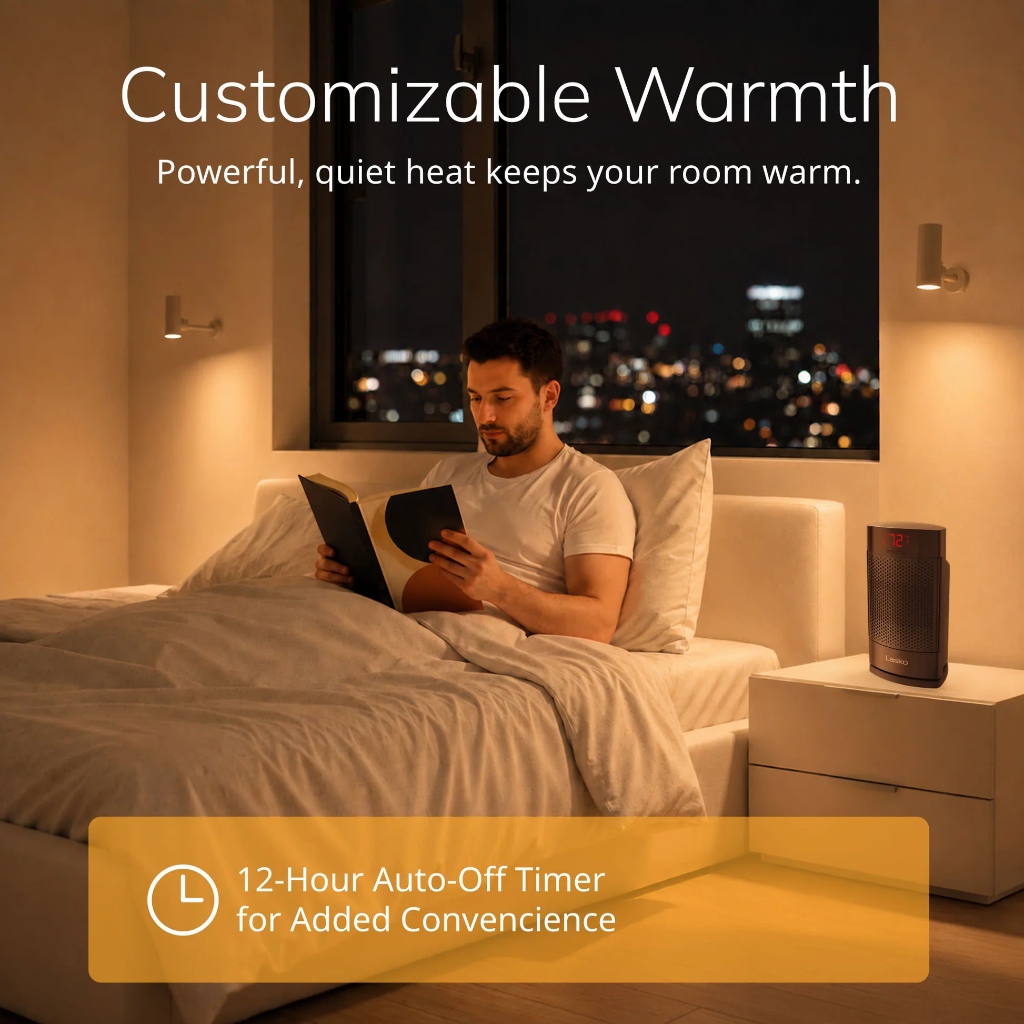
How often do you leave your desk for lunch or walk away at the end of the day and forget to turn off your space heater? A built-in timer (ranging from 1 to 12 hours) ensures the heater powers down automatically, preventing hours of unattended energy waste.
5. Child and Pet Safety Locks
In households with curious toddlers or playful pets, control panels placed at desk height are tempting targets. A Child Lock feature—which locks the digital controls so settings cannot be accidentally altered—adds an extra layer of operational peace of mind.
6. Remote Control Convenience
When you are on an important client video call or deep in focused spreadsheet work, leaning over to fiddle with floor controls breaks your concentration. A compact multi-function remote lets you adjust temperature, toggle oscillation, or silence the unit from your chair.
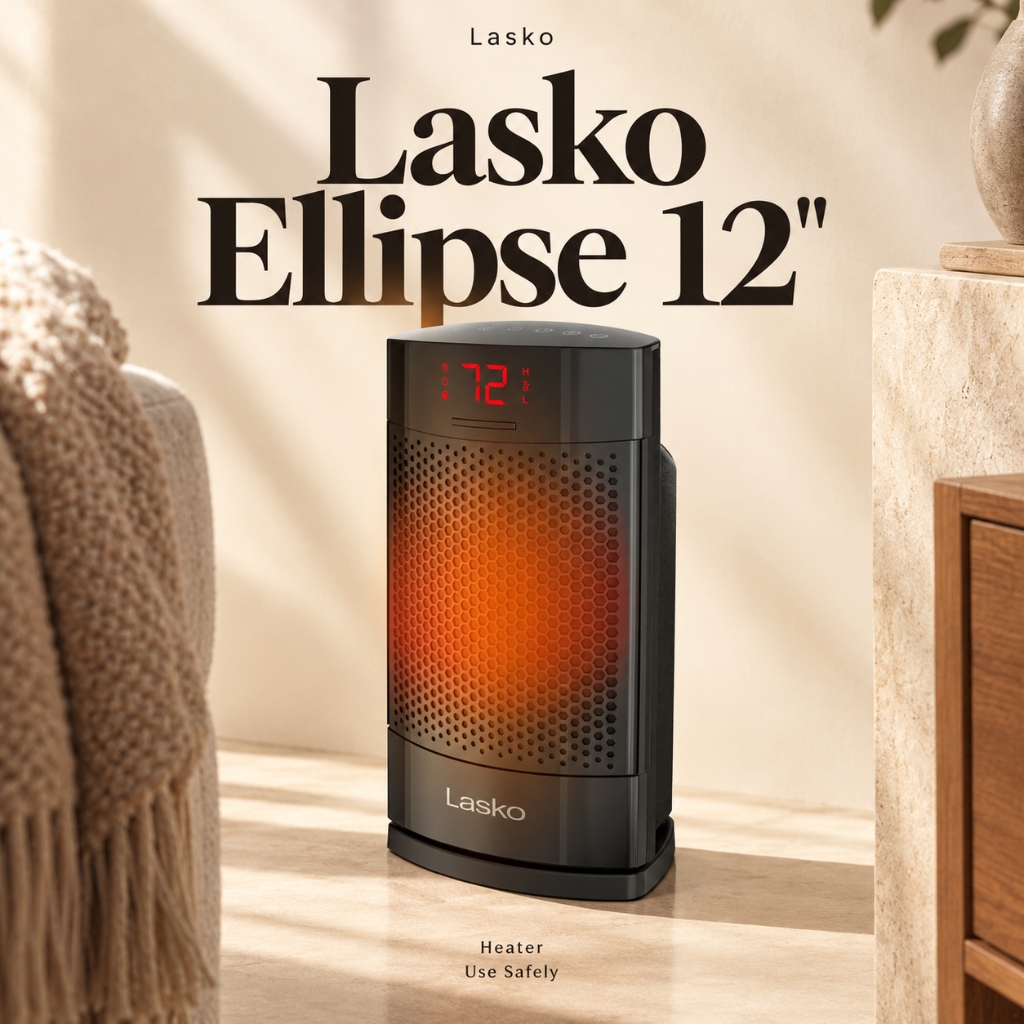
A Closer Look at the Lasko Ellipse 12" Ceramic Space Heater (CD12950)
To see how these practical criteria translate into a real consumer product, let us examine the Lasko Ellipse 12" Ceramic Space Heater (Model CD12950) as one representative compact option on the market today.
Verified Product Specifications & Design
According to official manufacturer documentation from Lasko Products, LLC:
- Form Factor: Compact tabletop/desk-side ceramic tower standing approximately 11.65 inches tall with an elliptical footprint of 4.86 inches deep by 6.11 inches wide.
- Chassis Weight: Approximately 3.1 pounds, making it exceptionally easy to reposition as your office layout evolves.
- Heating Element: Positive Temperature Coefficient (PTC) ceramic element discharging up to 1,500 Watts on High heat.
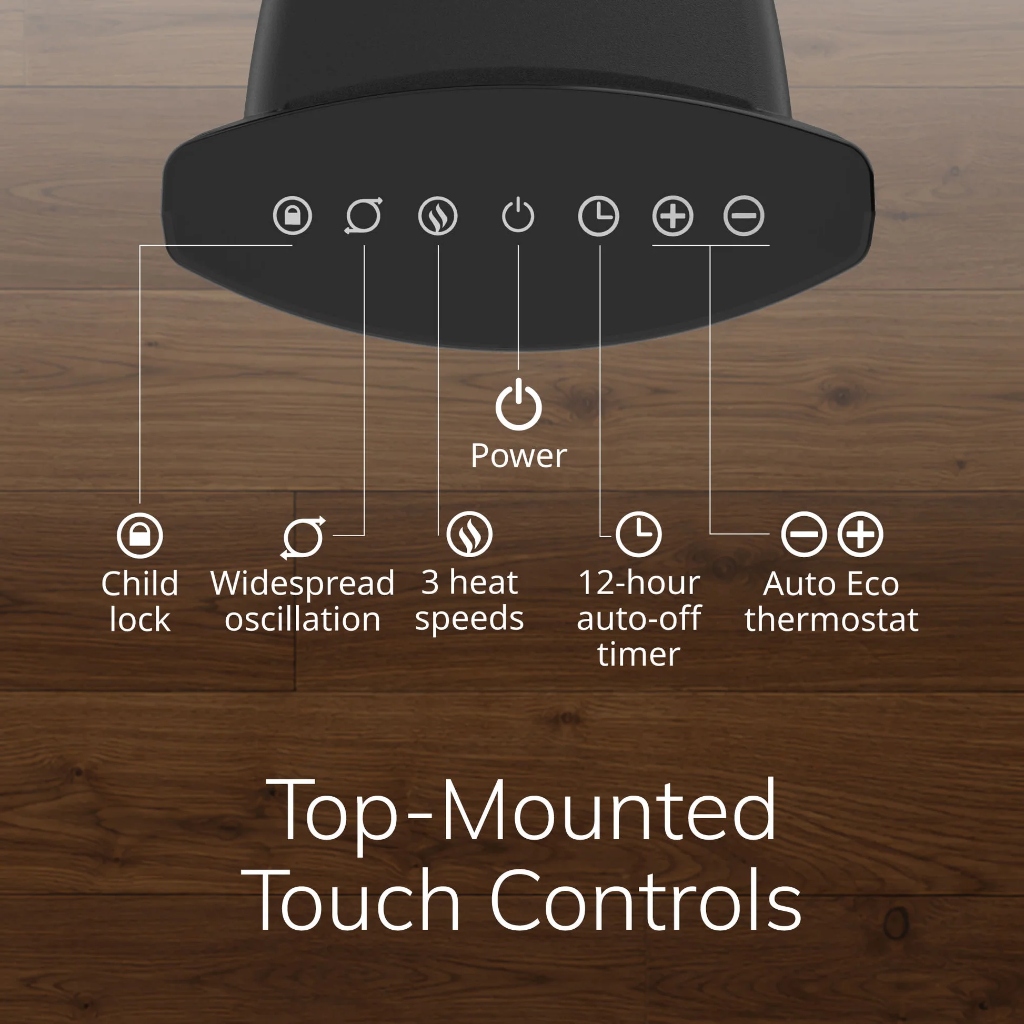
- Heat & Fan Settings: Three discrete heat settings (High / H3 at 1,500W, Medium / H2, and Low / H1) plus two fan speeds (F2 High and F1 Low).
- Oscillation Coverage: 120° Widespread Oscillation, utilizing a curved "Ellipse Edge" front grille designed to spread convective airflow across a broader personal seated perimeter.
- Thermostatic Control: Built-in AutoEco Mode, which regulates heat output to maintain a selected target comfort temperature while reducing overall electrical draw.
- Digital Controls & Remote: Touch-sensing top digital controls with an auto-dimming LED display, paired with a multi-function handheld remote control.
- Integrated Timer: Digital auto-off timer programmable in 30-minute increments up to 2 hours, and 1-hour increments up to 12 hours.
Safety Features and Child Lock
The Lasko Ellipse includes standard North American electrical safety certifications (ETL Listed / UL 1278 standard) and incorporates three critical protective mechanisms:
- 1.Tip-Over Safety Switch: A base microswitch that automatically terminates electrical power if the heater is accidentally bumped, tilted, or knocked off its base.
- 2.Overheat Thermal Limiter: An internal sensor that shuts down the heating elements if airflow intake or discharge is obstructed.
- 3.Child Lock Function: Enabled or disabled by holding the Child Lock button for 3 seconds. Once engaged, it disables all control panel inputs except the master Power button, preventing accidental changes by children or pets.
- 4.Cool-Touch Plastic Housing: The outer cabinet stays safely cool to the touch during operation, reducing contact burn risks.
Price and Availability Context
The site owner has supplied a current listed price of $69.99 for the Lasko Ellipse. In the compact ceramic category, this positions the Ellipse in the mid-range—priced above entry-level $30 mechanical heater boxes that lack digital thermostats, timers, and oscillation, but well below premium $150+ hybrid tower units.
Important Note on Pricing: While $69.99 represents the current price baseline supplied for this review, manufacturer listings, retailer promotions, and stock availability fluctuate throughout the heating season. We recommend verifying the current listing directly before buying.
Readers interested in checking current availability and purchasing options can view the Lasko Ellipse 12" Ceramic Space Heater on Lasko's official store. You can also inspect the detailed nameplate specifications on our Lasko Ellipse Product Spec Sheet.
Who Should Consider This Heater (and Who Should Look Elsewhere)?
No single climate appliance is right for every home. Understanding whether the Lasko Ellipse fits your specific living space depends on realistic expectations of thermal capacity.
Who the Lasko Ellipse 12" Is Best Suited For:
- 1.Enclosed Home Offices (100 to 150 Sq Ft): If you work in a standard suburban spare bedroom, den, or partitioned office with 8-foot ceilings, the Ellipse's 1,500W ceramic element and 120° oscillation provide ample supplemental warmth.
- 2.Desk and Credenza Workspaces: Remote workers with limited floor space who need an unobtrusive 12-inch vertical heater that can sit securely on a flat, sturdy surface away from loose paperwork.
- 3.Budget-Conscious Zone Heaters: Homeowners practicing central heating setbacks who want a modern digital heater with AutoEco cycling and auto-off timers without spending over $100.
- 4.Households with Pets or Young Children: The 3-second Child Lock and tip-over switch provide important baseline protections against accidental bumps or tampering.
Who Should Look for an Alternative Solution:
- 1.Large Open-Concept Floor Plans or Basements (>200 Sq Ft): A compact 12-inch heater cannot warm large, uninsulated spaces or rooms with vaulted 12-foot ceilings. In these environments, convective heat quickly rises and disperses. Consider a full-sized floor tower heater or evaluate your central HVAC duct balancing.
- 2.Anyone Needing Year-Round Active Air Conditioning: Like all space heaters, the fan-only mode on the Ellipse circulates ambient room air; it contains no compressor and cannot refrigerate an overheated office in summer.
- 3.Users Requiring Absolute Silence: While the Ellipse operates quietly, it relies on an internal blower fan to exhaust heat. If you record sensitive voiceover audio or cannot tolerate any fan noise, an oil-filled radiator is completely silent.
- 4.Offices Without Adequate Clearances: If your desk is surrounded by loose paper, storage boxes, and heavy drapery with less than 3 feet of clear perimeter, running any portable space heater creates an unacceptable fire hazard.
Home Office Space Heater Operating Costs: What Buyers Should Know
Before relying on a space heater for daily remote work, it is important to understand how electricity consumption translates into your monthly utility bill. Electric heating is 100% efficient at the point of use, but electricity in the US costs substantially more per BTU than natural gas.
The Daily Operating Cost Formula
Calculating the cost of operating any electric space heater is straightforward:
Daily Operating Cost ($) = Power Consumption (kW) × Hours Used × Electricity Price ($/kWh)
According to the latest residential electricity tariff benchmarks from the US Energy Information Administration (EIA), the national average retail price of residential electricity is approximately $0.168 per kWh (16.8 cents). Local tariffs vary widely, ranging from roughly $0.11/kWh in the Northwest to $0.28–$0.35/kWh in parts of California, Massachusetts, and Hawaii.
Realistic Home Office Cost Examples (8-Hour Workday at $0.168/kWh)
- 1.Continuous High Heat (1,500 Watts / 1.5 kW):
- Power consumption: 1.5 kW × 8 hours = 12.0 kWh per day
- Cost per workday: 12.0 kWh × $0.168/kWh = $2.02 per day
- Monthly cost (21 workdays): ~$42.40 per month
- Note: You will rarely need continuous 1,500W draw in a closed office once the room reaches operating temperature.
- 2.Continuous Low Heat (750 Watts / 0.75 kW):
- Power consumption: 0.75 kW × 8 hours = 6.0 kWh per day
- Cost per workday: 6.0 kWh × $0.168/kWh = $1.01 per day
- Monthly cost (21 workdays): ~$21.20 per month
- 3.Thermostatic AutoEco Cycling (~50% Effective Duty Cycle):
- When an electronic thermostat cycles between High, Low, and Off to maintain a set temperature (e.g., 68°F), the effective average power draw typically drops to roughly 750 Watts.
- Effective daily consumption: 6.0 kWh per 8-hour shift
- Cost per workday: $1.01 per day (~$21 per month)
How to Ensure Net Savings with Zone Heating
A supplemental space heater only lowers your overall energy expenditure if you lower your central heating thermostat throughout the rest of the house during the workday. If your central gas furnace is set back by 8°F while you heat only your 120 sq ft office, you can save $15 to $35 per month net, especially in homes heated by fuel oil, propane, or older heating equipment. For a full breakdown of the thermodynamics, read our guide on Space Heater vs. Central Heating Costs.
Space Heater Safety in a Home Office: Non-Negotiable Rules
The US Consumer Product Safety Commission (CPSC) and the National Fire Protection Association (NFPA) estimate that portable space heaters are involved in thousands of residential structure fires each year, often resulting from improper placement or overloaded electrical circuits.
No safety certification eliminates the need for responsible operation. To keep your home office safe, adhere strictly to these fire-prevention rules:
1. Maintain the 3-Foot Clearance Perimeter
Keep all combustible items at least 3 feet (36 inches) away from all sides of the space heater. In a home office, this means keeping the unit well clear of:
- Wastebaskets filled with paper
- Printer paper, files, and cardboard boxes
- Desk privacy skirts and upholstered office chairs
- Floor-length window draperies
2. Plug Directly into a Wall Outlet (Never Extension Cords or Power Strips)
A 1,500-watt heater draws 12.5 Amps on a standard 120V household circuit:
Current (Amps) = Power (Watts) ÷ Voltage (Volts) = 1,500W ÷ 120V = 12.5 Amps
Most household extension cords (16 AWG or 14 AWG) and common computer surge protectors are not engineered to carry a continuous 12.5A current load for eight hours. Internal contact resistance causes extension cords and multi-outlet strips to overheat, melting insulation and creating severe arc-fault fire risks. Always plug your heater directly into a permanent wall receptacle.
3. Account for Circuit Load Headroom
On a standard 15-Amp residential branch circuit, the National Electrical Code (NEC Article 210) specifies an 80% maximum continuous load limit of 12.0 Amps. At 12.5 Amps on High Heat, the space heater utilizes the full continuous capacity of the circuit.
- Rule: If your computer setup includes high-draw peripherals—such as a laser printer (which spikes up to 600–900W when fuser rollers heat up), a dual-GPU workstation, or a mini-fridge—plug the space heater into an outlet on a separate electrical circuit to avoid tripping your breaker.
4. Never Leave a Space Heater Operating Unattended
Turn off and unplug the space heater whenever you leave your home office for extended periods, such as running errands or ending your workday. Take advantage of built-in auto-off timers (such as the 12-hour timer on the Lasko Ellipse) as a safety backstop, but never use timers as a substitute for actively powering down the unit.
5. Proper Surface Placement
Place the heater on a flat, level, firm floor surface. Never position a space heater on soft surfaces like deep shag rugs or pillows that could block the bottom intake vents. If placing a compact unit on a desk or credenza, ensure the surface is completely sturdy, dry, level, and well away from desk edges.
Frequently Asked Questions About Home Office Space Heaters
Is a ceramic heater a good choice for a home office?
Yes. Ceramic space heaters are widely regarded as the most practical option for enclosed home offices between 100 and 200 square feet. Their Positive Temperature Coefficient (PTC) heating blocks discharge noticeable warmth within 45 to 60 seconds, and their compact footprint easily accommodates tight workspaces without crowding legroom.
Does an oscillating heater distribute warmth differently?
Yes. A stationary space heater discharges a narrow, direct column of heat that can create an uncomfortable hotspot if pointed directly at your legs. An oscillating heater sweeps convective airflow through a 90° to 120° arc, warming the broader seated desk perimeter and distributing temperature more evenly throughout the room.
How much does a space heater cost to operate during an 8-hour workday?
At the US national average electricity rate of approximately $0.168 per kWh (US EIA benchmark), running a 1,500-watt space heater continuously on High costs roughly $2.02 per 8-hour day. However, using a lower heat setting (such as 750W Low) or an automatic thermostat that cycles power drops that cost to roughly $1.01 per day (~$21 per month for 21 workdays).
Can a space heater be left running while you leave the room?
No. The Consumer Product Safety Commission (CPSC) and fire safety experts strongly advise against running portable space heaters in unattended rooms. Always power off the unit when stepping away for lunch or leaving your office. While automatic timers provide a helpful safety shut-off, they should not replace manual shut-down habits.
What safety features should a home-office heater have?
A home office space heater should include an independent safety certification from ETL or UL (meeting the UL 1278 standard), an internal tip-over switch that immediately kills power if the unit is knocked over, automatic overheat thermal protection, a cool-touch exterior housing, and ideally a child lock to prevent accidental button presses.
Is a compact 12-inch heater suitable for a large room?
No. All compact 120V electric heaters are capped at 1,500 Watts (5,118 BTU/h). In spaces larger than 200 square feet or rooms with open floor plans and high ceilings, the heat dissipates too rapidly for a compact unit to warm the entire room. In large spaces, a compact heater only provides localized, personal warmth if placed within 3 to 5 feet of your chair.
Conclusion: Making the Right Heating Choice for Your Workspace
Staying productive during cold winter workdays requires an indoor climate where you can focus without shivering or constantly fidgeting with blankets. Attempting to heat an entire home with your central furnace just to stay comfortable at your desk is an expensive, inefficient approach.
A well-chosen compact ceramic space heater bridges this gap by delivering targeted, responsive warmth exactly where and when you need it. When shopping for your home office:
- 1.Prioritize a compact vertical footprint that preserves floor and desk space.
- 2.Ensure the unit provides multiple heat settings and widespread oscillation to prevent localized hotspots.
- 3.Insist on certified safety protections, including tip-over switches, overheat cut-offs, and cool-touch surfaces.
- 4.Always plug directly into a dedicated wall outlet and maintain a strict 3-foot clearance perimeter.
The Lasko Ellipse 12" Ceramic Space Heater (CD12950) is an example of an appliance that effectively brings these criteria together. With its space-saving 12-inch profile, 120° widespread oscillation, 3 heat settings, AutoEco thermostat, and integrated child lock, it offers a well-rounded feature set for home workers looking for focused comfort.
If its verified specifications and supplied $69.99 price point match your home office requirements, you can check current availability and purchase options for the Lasko Ellipse directly on Lasko's official store. By practicing disciplined zone heating and observing basic electrical safety, you can keep your workspace comfortable all winter long without driving up your heating bills.
Technical Assumptions & Boundary Conditions
- •Supplemental Zone Coverage Only: A 1,500W compact heater has an absolute physical ceiling of 5,118 BTU/h. It is engineered for supplemental warmth in spaces under 200 sq ft and cannot heat open floor plans or drafty rooms.
- •Desk Placement Caveats: While compact 12-inch heaters can fit on large sturdy credenzas or desks, placing any space heater on elevated surfaces increases tip-over risks; floor placement on level, uncarpeted flooring is always preferred.
- •Dynamic Retail Pricing: The $69.99 price for the Lasko Ellipse was supplied by the site owner at the time of publication and is subject to manufacturer and retail adjustments.
- •Continuous Draw Headroom: Pulling 12.5 Amps leaves only 2.5 Amps of safety headroom on a standard 15-Amp residential branch circuit, meaning operating high-draw office gear on the same circuit can trip breakers.
Referenced Equipment & Specification Sheets
Lasko Ellipse 12" Ceramic Space Heater
Home offices, desks, dens, and bedrooms up to 150 sq ft needing compact supplemental warmth and tabletop versatility
Key Strengths
- •Compact 11.65-inch vertical profile with a 4.86" x 6.11" footprint well-suited for home office desks and compact workspaces
- •120-degree widespread oscillation distributes convective warmth across a broader seated personal zone
- •Positive Temperature Coefficient (PTC) ceramic heating element delivers rapid supplemental heat within 60 seconds
Known Limitations
- •High-heat mode draws up to 12.5 Amps (1,500W), requiring a dedicated 120V wall receptacle (never extension cords or power strips)
- •Personal/desk-zone supplemental heater; not designed to heat large rooms, vaulted spaces, or open-concept living plans
- •Price and availability subject to change from the supplied $69.99 baseline; check official manufacturer listing before purchasing
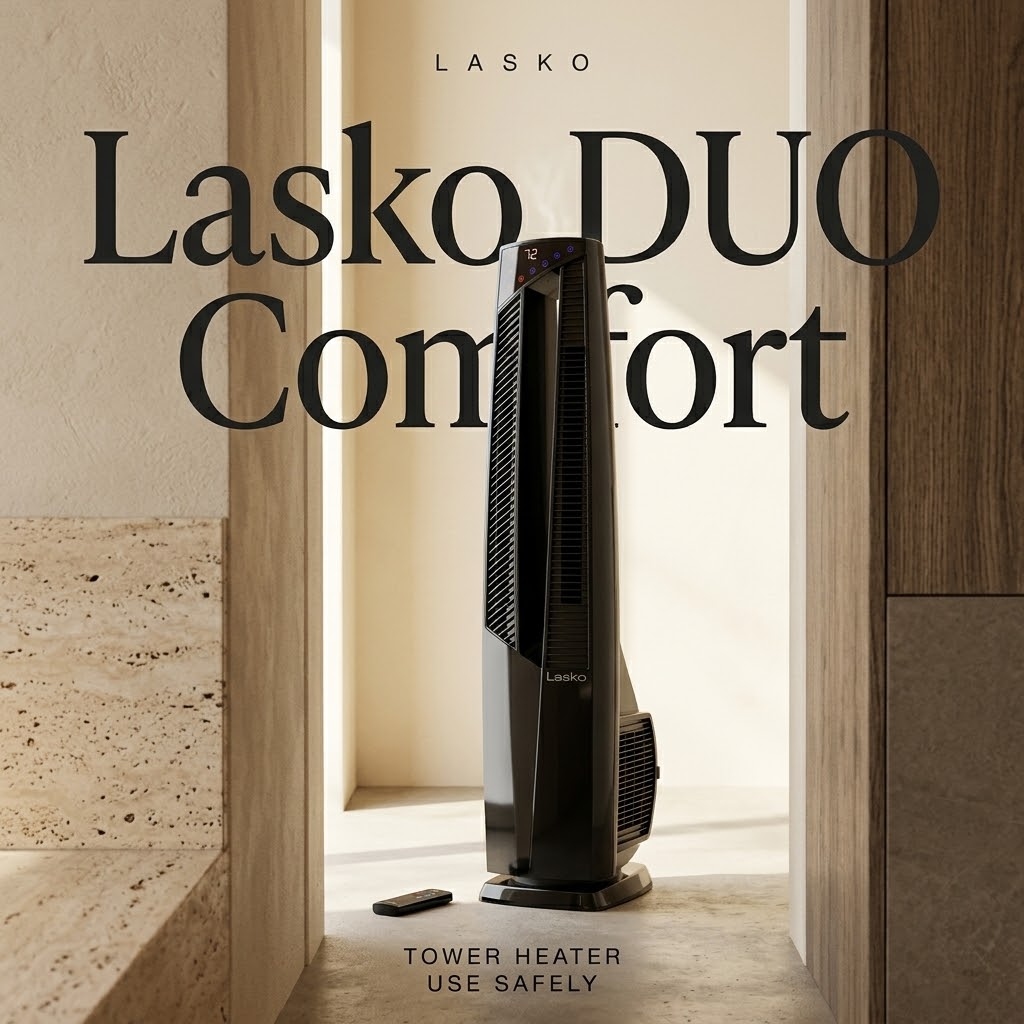
Lasko DUO Comfort 38" DC Tower Fan & Ceramic Space Heater
Bedrooms, home offices, and living spaces up to 300 sq ft needing all-season comfort with zero off-season appliance storage
Key Strengths
- •Year-round 2-in-1 hybrid design eliminates off-season storage headaches by combining tower fan and ceramic heater
- •Brushless DC motor (WhisperForce) provides smooth, low-wattage air circulation across 4 speeds
- •1,500W ceramic PTC element delivers rapid supplemental warmth with 3 heat settings
Known Limitations
- •Not an air conditioner: Fan mode circulates ambient air via wind-chill effect without lowering sensible room temperature
- •High-heat mode draws up to 12.5 Amps (1,500W), requiring a dedicated 120V wall outlet (never extension cords or power strips)
- •Manufacturer coverage of up to 300 sq ft is supplemental; heating performance varies significantly in drafty or high-ceiling spaces
Primary Sources & Regulatory References
- [1]Lasko Ellipse 12" Ceramic Space Heater Specifications & Manual — Lasko Products, LLC
- [2]Reducing Fire Hazards for Portable Electric Heaters — US Consumer Product Safety Commission (CPSC)
- [3]Home Heating Safety Tips & Space Heater Statistics — National Fire Protection Association (NFPA)
- [4]Energy Saver: Thermostats and Heating Setbacks — US Department of Energy (DOE)
- [5]Electric Power Monthly: Average Retail Price of Electricity — US Energy Information Administration (EIA)
- [6]
Frequently Asked Questions
Is a ceramic heater a good choice for a home office?
Yes. Ceramic space heaters are widely regarded as the most practical option for enclosed home offices between 100 and 200 square feet. Their Positive Temperature Coefficient (PTC) heating blocks discharge noticeable warmth within 45 to 60 seconds, and their compact footprint easily accommodates tight workspaces without crowding legroom.
Does an oscillating heater distribute warmth differently?
Yes. A stationary space heater discharges a narrow, direct column of heat that can create an uncomfortable hotspot if pointed directly at your legs. An oscillating heater sweeps convective airflow through a 90° to 120° arc, warming the broader seated desk perimeter and distributing temperature more evenly throughout the room.
How much does a space heater cost to operate during an 8-hour workday?
At the US national average electricity rate of approximately $0.168 per kWh (US EIA benchmark), running a 1,500-watt space heater continuously on High costs roughly $2.02 per 8-hour day. However, using a lower heat setting (such as 750W Low) or an automatic thermostat that cycles power drops that cost to roughly $1.01 per day (~$21 per month for 21 workdays).
Can a space heater be left running while you leave the room?
No. The Consumer Product Safety Commission (CPSC) and fire safety experts strongly advise against running portable space heaters in unattended rooms. Always power off the unit when stepping away for lunch or leaving your office. While automatic timers provide a helpful safety shut-off, they should not replace manual shut-down habits.
What safety features should a home-office heater have?
A home office space heater should include an independent safety certification from ETL or UL (meeting the UL 1278 standard), an internal tip-over switch that immediately kills power if the unit is knocked over, automatic overheat thermal protection, a cool-touch exterior housing, and ideally a child lock to prevent accidental button presses.
Is a compact 12-inch heater suitable for a large room?
No. All compact 120V electric heaters are capped at 1,500 Watts (5,118 BTU/h). In spaces larger than 200 square feet or rooms with open floor plans and high ceilings, the heat dissipates too rapidly for a compact unit to warm the entire room. In large spaces, a compact heater only provides localized, personal warmth if placed within 3 to 5 feet of your chair.
Our editorial staff evaluates residential heating, cooling, airflow, and indoor air quality appliances against published US engineering and safety standards.
Related Climate & Comfort Guides
Space Heater vs. Central Heating: When Supplemental Heating Actually Saves Money
An evidence-based thermodynamic analysis of space heaters vs central heating. Compare fuel costs per BTU, setback schedules, and zone heating economics.
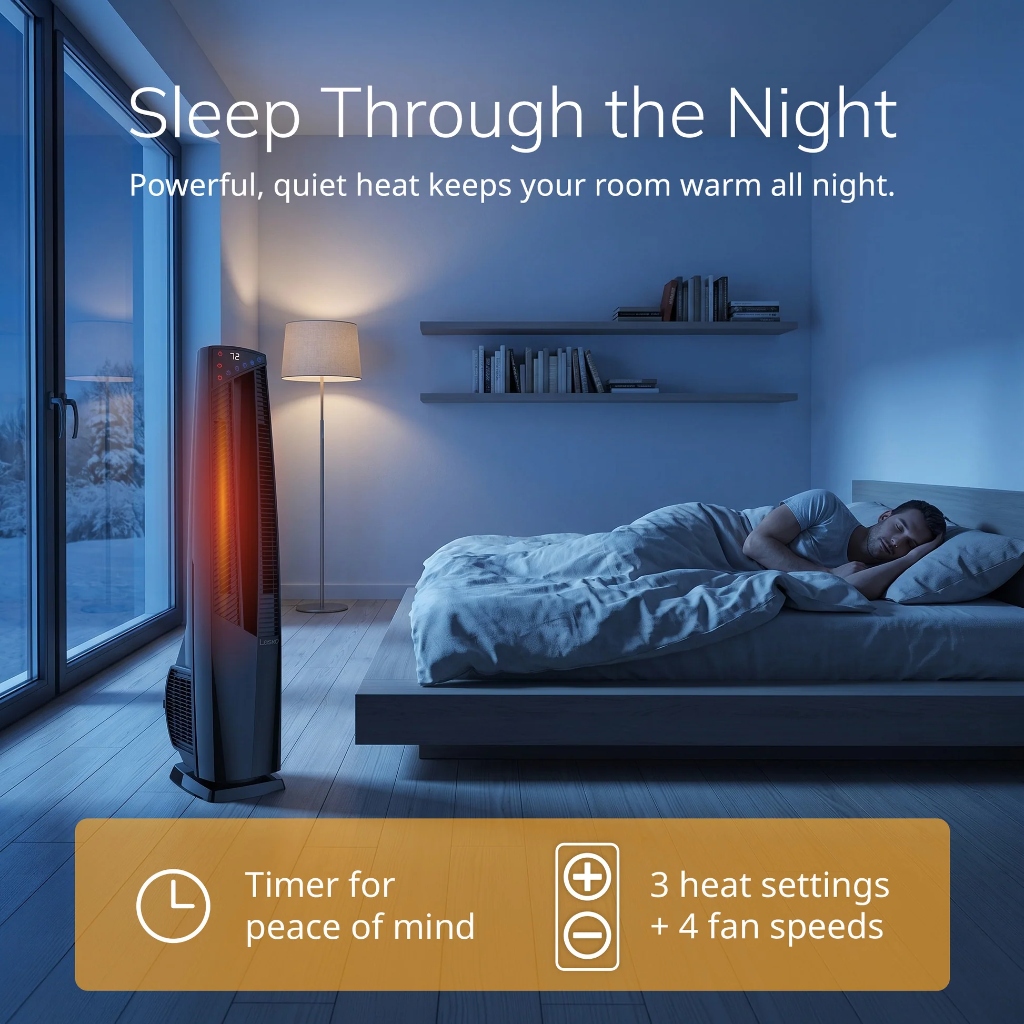
Lasko DUO Comfort 38-Inch DC Fan and Heater Review (Model FHV830)
An independent, research-based review of the Lasko DUO Comfort 38" DC fan and space heater (FHV830). Verified manufacturer specs, AutoEco behavior, safety, and operating costs.