
Space Heater vs. Central Heating: When Supplemental Heating Actually Saves Money
An evidence-based thermodynamic analysis of space heaters vs central heating. Compare fuel costs per BTU, setback schedules, and zone heating economics.
Editorial Transparency & Affiliate Disclosure
Air Crafted Home may earn a commission when you purchase through links on this site, at no additional cost to you. Affiliate relationships do not automatically determine our editorial conclusions. Our recommendations are strictly supported by physical evidence, building-science standards (DOE, AHAM, EPA), and transparent evaluation criteria. Read full disclosure and evaluation methodology.
A 1,500-watt electric space heater only saves money compared to central heating when paired with disciplined whole-home thermostat setbacks—a strategy known as zone heating. Because residential electricity costs an average of $0.168 per kWh ($49.20 per million BTU) compared to approximately $1.30 to $1.50 per therm for natural gas ($13.00 to $15.00 per million BTU), electric resistance heating is 3 to 4 times more expensive per unit of heat than a gas furnace. However, lowering your central thermostat by 7°F to 10°F throughout an entire 1,800- to 2,500-square-foot home reduces building envelope heat loss by 10% to 15%. Warming only a single 150- to 300-square-foot occupied room (such as a bedroom or home office) with a thermostatic ceramic heater like the Lasko DUO Comfort FHV830 costs roughly $0.80 to $1.34 per 8-hour shift, yielding a net monthly household savings of $15 to $40. If the central thermostat is not set back, running a space heater is purely additive and increases your utility bills.
Core Takeaways
- •The Fuel Cost Reality: At US average residential utility rates ($0.168/kWh electricity vs $1.40/therm natural gas), electric resistance heating costs roughly 3.5 times more per delivered BTU than a standard 80% AFUE natural gas furnace.
- •The Zone Heating Tipping Point: Supplemental heating only generates net financial savings if you lower the central thermostat across the unoccupied house by at least 7°F to 10°F for 8 or more hours.
- •Conditioned Area Ratio: Zone heating delivers maximum economic return in homes over 1,500 sq ft where the occupied zone represents less than 20% of the total conditioned floor plan.
- •Thermostat Modulation Matters: Using a heater with an electronic thermostat (like the Lasko FHV830's AutoEco control) prevents continuous 1,500W draw, cutting space heater electricity consumption by 30% to 50% compared to basic unmodulated heaters.
- •Strict Electrical Safety: A 1,500W space heater draws 12.5 Amps on a standard 120V US circuit; it must be plugged directly into a dedicated wall outlet with 3 feet of clearance from combustibles per CPSC guidelines.
Independent Technical Consensus & Thermodynamic Modeling: This analysis is synthesized from US Energy Information Administration (EIA) residential utility price data, US Department of Energy (DOE) building envelope heat loss principles, Consumer Product Safety Commission (CPSC) residential heating safety codes, and manufacturer nameplate specifications. Air Crafted Home does not accept sponsored placements or manufacturer incentives.
Comparative Performance Analysis
| Evaluation Criteria | Central Heating Alone (Whole-Home) | Central Heat + Zone Space Heater (Setback Strategy) | Engineering Verdict |
|---|---|---|---|
| Conditioned Living Area | Entire home (1,800 – 2,500 sq ft kept at 68°F–70°F) | Whole house set back to 60°F–62°F; only 150 – 300 sq ft occupied room heated | Zone Heating (Reduces heated volume by 80%+) |
| Fuel Cost per Million BTU | $14.00 – $18.00 (Gas) / $15.00 – $22.00 (Heat Pump) | $45.00 – $55.00 (Electricity per delivered space heater BTU) | Central Heat (Significantly lower cost per thermal unit) |
| Envelope Heat Loss Rate | High; maximum temperature differential across all exterior walls and attic | 10% – 15% reduction in overall building thermal envelope heat loss | Zone Heating (Less total heat escapes into the winter air) |
| 8-Hour Overnight Cost | $3.50 – $7.00 per night (maintaining whole-house comfort) | $2.20 – $4.30 per night ($1.40 reduced central base + $0.80–$1.20 space heater) | Zone Heating ($1.30 – $2.70 daily net savings) |
| Equipment Purchase Cost | Existing central furnace / heat pump; $0 additional upfront spend | $120 – $160 for a quality ceramic tower heater with AutoEco thermostat | Central Heat (No additional equipment purchase required) |
| Comfort Distribution | Uniform temperature in all rooms; unoccupied hallways and guest rooms heated | Targeted comfort in occupied bedroom/office; rest of home remains cool | Tie (Depends on household occupancy patterns and lifestyle) |
Appliance Efficiency vs. Fuel Cost: The 100% Efficiency Myth
Every winter, manufacturers of portable electric space heaters advertise their products as "100% energy efficient." Thermodynamically, this claim is technically accurate: electric resistance heating (Joule heating) converts virtually 100% of the electrical energy drawn from the wall receptacle directly into sensible heat, with a negligible fraction powering indicator LEDs or the quiet fan motor. One Watt-hour of electricity reliably yields 3.412 BTU of thermal energy. On a standard US 120-volt circuit, a 1,500-watt space heater running at full capacity consistently outputs 5,118 BTU per hour.
However, appliance conversion efficiency is not the same as operating cost efficiency. To understand why running a space heater often causes electric bills to skyrocket, we must compare the cost per delivered unit of heat across common residential fuel sources in the United States.
Comparing Residential Fuel Costs per Million BTU (MMBtu)
According to baseline data from the US Energy Information Administration (EIA):
- 1.Natural Gas (Standard 80% to 95% AFUE Central Furnace):
- Natural gas is priced in therms (1 therm = 100,000 BTU). At an average US residential tariff of ~$1.40 per therm, delivering 1,000,000 BTU of heat through an 80% AFUE furnace costs approximately $17.50. In a modern 95% AFUE condensing furnace, that cost drops to $14.74.
- 2.Cold-Climate Heat Pump (Air-Source, COP 2.5 to 3.2):
- Modern air-source heat pumps move heat rather than generating it through electrical resistance. At an average US electricity rate of $0.168 per kWh and an outdoor operating Coefficient of Performance (COP) of 2.8, delivering 1,000,000 BTU costs approximately $17.57.
- 3.Electric Resistance Space Heater (100% Efficient / COP 1.0):
- Generating 1,000,000 BTU through pure electrical resistance requires 293 kWh of electricity. At the US national average residential electricity tariff of $0.168 per kWh, generating that same 1,000,000 BTU costs $49.22.
- 4.Residential Heating Oil & Propane:
- Heating oil at $3.80/gallon (85% AFUE) costs roughly $32.10 per million BTU. Propane at $3.20/gallon (85% AFUE) costs roughly $41.10 per million BTU.
The Thermal Cost Reality
On a pure unit-for-unit basis, electric resistance heat is 2.8 to 3.5 times more expensive than natural gas or heat pump heating.
If you turn on an electric space heater without lowering your central furnace thermostat, you are paying a heavy premium for supplemental warmth. For a space heater to actually save you money on your overall utility bills, you must pair it with a disciplined building-science strategy: Zone Heating.
The Zone Heating Equation: The Tipping Point for Net Savings
If electricity is more than three times more expensive per BTU than natural gas, how can using a space heater ever lower your total energy bill? The financial justification relies on a simple principle of building thermodynamics: reducing the total conditioned volume of the home.
Heat loss through a building envelope follows Fourier's law of thermal conduction:
Q = U × A × (T_in - T_out)
Where:
- Q is the total rate of heat loss from your home (BTU/h).
- U is the thermal transmittance (U-factor) of your walls, windows, and attic insulation.
- A is the total exterior surface area of the building envelope (sq ft).
- (T_in - T_out) is the temperature differential between indoor living space and outdoor winter air (°F).
When your central heating system keeps an entire 2,000-square-foot house at 68°F overnight, it must burn fuel to replace the heat escaping through every exterior wall, window, ceiling, and doorway across the entire structure—including unoccupied living rooms, dining rooms, kitchens, hallways, and spare bedrooms.
By setting back your central thermostat by 7°F to 10°F (for instance, dropping the whole-house setpoint from 68°F down to 60°F overnight) and using a portable space heater to warm only the 150- to 250-square-foot bedroom you actually occupy, you drastically shrink the heated volume.
The US Department of Energy (DOE) establishes that a disciplined 7°F to 10°F thermostat setback for 8 hours per day reduces total building heating energy consumption by 7% to 10%.
Worked Case Study: 2,000 Sq Ft Home Overnight Heating
To demonstrate the exact financial tipping point, consider a typical 2,000-square-foot home on a 32°F winter night:
Scenario A: Whole-Home Central Gas Heating (No Setback)
- Central thermostat set to 68°F continuously across the entire 2,000 sq ft home.
- Gas furnace consumes an average of 0.40 therms per hour overnight (3.2 therms over 8 hours).
- Overnight heating cost: 3.2 therms × $1.40/therm = $4.48 per night (~$134.40/month).
Scenario B: Zone Heating (8°F Central Setback + Supplemental Bedroom Heater)
- Central thermostat set back from 68°F to 60°F from 10 PM to 6 AM (8 hours).
- Reduced indoor-to-outdoor temperature differential drops central furnace runtime by approximately 25%.
- Reduced central furnace consumption: 2.4 therms × $1.40/therm = $3.36 per night.
- An energy-efficient ceramic space heater with an electronic thermostat—such as the Lasko DUO Comfort 38" DC (FHV830)—warms the closed 200 sq ft master bedroom to 68°F.
- Because of thermostat cycling, the 1,500W heater operates at an effective 50% duty cycle (750 Watts average draw).
- Space heater electricity consumption: 0.75 kW × 8 hours = 6.0 kWh.
- Space heater electricity cost: 6.0 kWh × $0.168/kWh = $1.01 per night.
- Total combined overnight cost: $3.36 (gas furnace) + $1.01 (space heater) = $4.37 per night (~$131.10/month).
- Net result: Net savings of ~$0.11 to $0.40 per night ($3.30 to $12.00/month) against cheap natural gas.
Scenario C: Homes Heated by Fuel Oil or Propane (High Savings)
In homes heated by fuel oil ($3.80/gal) or propane ($3.20/gal), the fuel cost per million BTU is roughly double that of natural gas.
- An 8°F overnight setback reduces oil/propane consumption by ~$2.40 to $3.20 per night.
- The space heater still consumes $1.01 in electricity.
- Net monthly savings: $40 to $65 per month.
When Zone Heating Fails (Cost Spikes)
Zone heating backfires under three common conditions:
- 1.No Central Setback: Leaving the central thermostat at 68°F while running a space heater simply adds $25 to $45 per month of electricity onto your existing utility bill.
- 2.Multiple Space Heaters: Running two or three space heaters in different bedrooms simultaneously consumes 12 to 24 kWh per night ($60 to $120/month), wiping out whole-house setback gains.
- 3.Small Floor Plans (<700 sq ft): In small apartments, the total building envelope is compact. An 8°F setback saves only pennies per night on central heating, which is easily erased by electric space heating.
Thermostat Modulation and Duty Cycles: Why Ceramic PTC Outperforms Basic Coils
Not all electric space heaters operate with the same electrical efficiency. While all electric heaters convert 100% of their wattage into heat, the way they cycle that wattage determines how much electricity you actually use.
The Inefficiency of Basic Resistance Heaters
Entry-level space heaters typically use exposed nichrome wire coils or simple radiant quartz tubes controlled by crude mechanical bimetallic thermostats. These thermostats suffer from severe temperature hysteresis:
- They blast 1,500 Watts continuously until the room is overheated by 4°F to 6°F.
- They shut completely off until the room drops well below the comfort threshold.
- In many cases, users set the dial to "High" and leave it running continuously. At 1,500 Watts continuous draw, an 8-hour overnight run consumes 12.0 kWh ($2.02 per night at US average rates, or over $60 per month).
The Ceramic PTC Advantage
Modern hybrid ceramic towers—such as the Lasko DUO Comfort 38" DC (FHV830)—use Positive Temperature Coefficient (PTC) ceramic heating blocks.
PTC ceramic elements possess unique physical properties:
- 1.Self-Regulating Material Resistance: As ceramic stones reach their designed operating temperature, their internal electrical resistance naturally rises, preventing dangerous thermal runaway and stabilizing power draw.
- 2.Rapid Convective Warmth: Ceramic blocks transfer heat quickly to moving air, discharging warm convective currents within 45 to 60 seconds without the delayed warm-up curve of oil-filled radiators.
- 3.Automated Power Modulation (AutoEco Logic): Rather than blasting full wattage indefinitely, intelligent electronic thermostats actively stage the heating elements:
- High Heat (1,500W): Operates during initial room warm-up when room temperature is below target.
- Low Heat (~750W to 900W): Automatically downshifts as ambient temperature approaches the setpoint, maintaining steady warmth with lower amperage draw.
- Automatic Shut-Off & Recirculation: Powers down the heating element when the space reaches ~4°F above the set target, running the brushless DC fan for approximately 15 seconds to safely dissipate residual element heat.
By actively downshifting wattage and cycling based on room conditions, an AutoEco-controlled ceramic heater reduces the effective duty cycle to 40%–55%, consuming only 4.8 to 6.6 kWh over an 8-hour night ($0.81 to $1.11). This difference is often what preserves net zone heating savings.
Electrical Infrastructure, Branch Limits, and CPSC Fire Safety Standards
A space heater is the single most demanding 120-volt portable appliance commonly used in American residences. Operating a 1,500-watt appliance requires careful adherence to the National Electrical Code (NEC) and safety standards established by the US Consumer Product Safety Commission (CPSC).
Understanding the 12.5-Amp Continuous Load
In US residential wiring, standard household wall outlets are supplied by 120-volt alternating current (AC) on 15-Amp or 20-Amp branch circuits:
Current (Amps) = Power (Watts) ÷ Voltage (Volts) = 1,500W ÷ 120V = 12.5 Amps
Under NEC Article 210, an electrical load that runs continuously for 3 hours or longer is classified as a continuous load and should not exceed 80% of the branch circuit rating:
- A standard 15-Amp branch circuit has an 80% continuous rating of 12.0 Amps.
- At 12.5 Amps, a 1,500-watt space heater operates right at the threshold of a 15-Amp breaker's continuous capacity.
- Critical Circuit Rule: A 1,500-watt space heater must never share an active branch circuit with other high-wattage devices (hair dryers, vacuums, coffee makers, microwave ovens, or gaming PCs). If your bedroom circuit breaker frequently trips, check what other electronics are powered on that same circuit.
The Absolute Ban on Extension Cords and Power Strips
The CPSC reports that space heaters account for an estimated 1,700 residential structure fires and roughly 70 deaths annually in the United States, with a substantial portion caused by improper electrical connections.
- Why Extension Cords Fail: Standard household extension cords (typically 16 AWG or 14 AWG) and surge protectors are not engineered to handle sustained 12.5-Amp current for 8 consecutive hours. The internal contact resistance within cheap plug blades and strip receptacles causes localized overheating, melting plastic insulation and creating direct arc-fault fire hazards.
- Requirement: Always plug an electric space heater directly into a permanent wall outlet. Never use extension cords, power strips, or multi-plug splitters.
The 3-Foot Clearance Perimeter
Convective and radiant space heaters emit high-density thermal energy from their front grilles. The CPSC mandates maintaining a minimum 3-foot (36-inch) clearance perimeter around all sides of the appliance:
- Keep all bedding, blankets, pillows, draperies, upholstered furniture, and loose clothing at least 3 feet away.
- Position the unit on a firm, flat, level floor surface. Never place a space heater on top of dressers, nightstands, chairs, or deep shag rugs that might block bottom air intake vents.
Non-Negotiable Safety Features for Overnight Use
When selecting a space heater for bedroom zone heating, verify that the unit includes these third-party certified safety features:
- 1.Tip-Over Microswitch: A mechanical or electronic switch in the base that immediately terminates power if the heater is knocked over by a pet or tripped over in the dark.
- 2.Automatic Overheat Thermal Cutoff: An internal high-limit thermostat that cuts power if airflow is restricted (e.g., if clothing falls across the intake grille).
- 3.Independent Safety Listing: Look for certified marks from ETL (Intertek) or UL (Underwriters Laboratories) verifying compliance with the UL 1278 standard for electric space heaters.
- 4.Cool-Touch Exterior: Ensures the outer housing remains safe to brush against without causing contact burns.
The Zone Heating Decision Framework: Who Benefits and Who Should Avoid It
To determine whether purchasing a supplemental space heater will save you money or increase your energy bills, use this practical decision framework before buying:
When Zone Heating Saves Money (Ideal Candidates):
- Single Occupants or Couples: You spend 8+ consecutive hours sleeping in one bedroom or working in a home office while the rest of the house sits empty.
- Homes Over 1,500 Square Feet: Your occupied zone represents less than 20% of your total conditioned floor area, maximizing the savings from setting back the central system.
- Homes Heated by Heating Oil, Propane, or Inefficient Baseboards: Your primary fuel cost per million BTU is high ($30 to $45/MMBtu), making supplemental electric heat economically advantageous during setbacks.
- Disciplined Setback Habits: You consistently lower your central thermostat by 7°F to 10°F during unoccupied hours.
- Thermostatic Equipment: You use a modern ceramic tower heater—such as the Lasko DUO Comfort 38" DC (FHV830)—that combines PTC ceramic heating with an automatic electronic thermostat to prevent wasteful continuous 1,500W operation.
When Zone Heating Loses Money (Avoid and Stick to Central Heat):
- Families with Multiple Occupied Bedrooms: If children and parents sleep in separate rooms, you would need multiple space heaters running simultaneously. Two space heaters draw 25 Amps (exceeding standard branch limits) and consume more electricity than running your central furnace.
- Compact Apartments (<700 sq ft): Setting back central heating in a small apartment yields negligible savings that are easily wiped out by space heater electricity use.
- Open-Concept Spaces Without Doors: If your bedroom or office cannot be closed off, convective heat quickly spills into cooler adjacent living areas, forcing the heater to run continuously at 1,500 Watts.
- Regions with High Electricity Tariffs: In areas where electricity rates exceed $0.28 to $0.35 per kWh (such as parts of California, Massachusetts, and Hawaii) and natural gas is cheap, electric space heating almost never breaks even against a gas furnace.
Technical Assumptions & Boundary Conditions
- •Regional Utility Tariff Variance: In areas with high electric tariffs (e.g., California, Hawaii, Massachusetts at $0.28 to $0.35/kWh) and low gas prices, the central thermostat setback must be deeper (10°F+) for supplemental electric heating to break even.
- •Thermal Stratification & High Ceilings: Rooms with vaulted ceilings (>9 ft) or drafty single-pane windows experience accelerated convective heat rise and draft loss, reducing zone heating efficiency.
- •Appliance Heating Ceiling: A 1,500-watt heater is capped by physics and electrical codes at 5,118 BTU/h. It cannot warm spaces larger than 300 sq ft during severe sub-freezing weather.
- •Circuit Headroom Constraint: Drawing 12.5 Amps leaves only 2.5 Amps of safety margin on a standard 15-Amp residential branch circuit, meaning co-located lights or appliances can trip circuit breakers.
Referenced Equipment & Specification Sheets
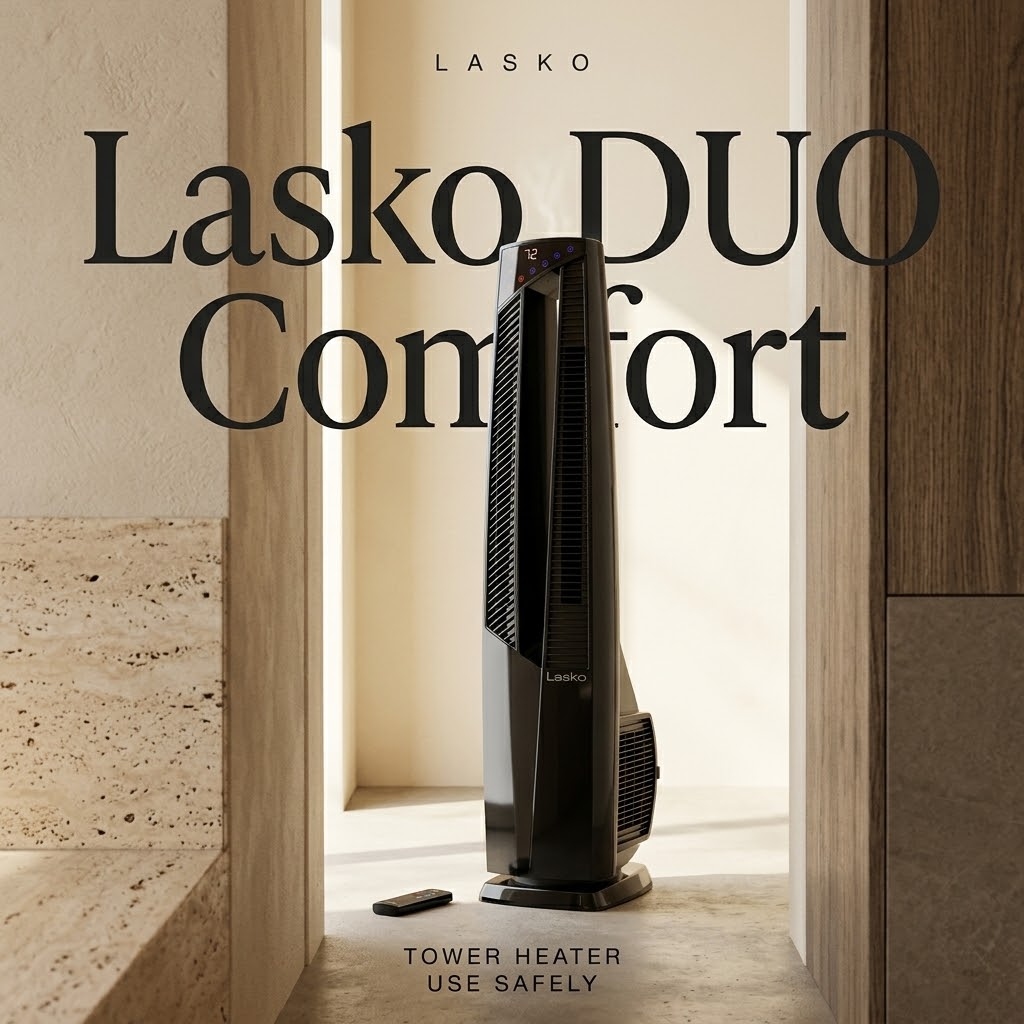
Lasko DUO Comfort 38" DC Tower Fan & Ceramic Space Heater
Bedrooms, home offices, and living spaces up to 300 sq ft needing all-season comfort with zero off-season appliance storage
Key Strengths
- •Year-round 2-in-1 hybrid design eliminates off-season storage headaches by combining tower fan and ceramic heater
- •Brushless DC motor (WhisperForce) provides smooth, low-wattage air circulation across 4 speeds
- •1,500W ceramic PTC element delivers rapid supplemental warmth with 3 heat settings
Known Limitations
- •Not an air conditioner: Fan mode circulates ambient air via wind-chill effect without lowering sensible room temperature
- •High-heat mode draws up to 12.5 Amps (1,500W), requiring a dedicated 120V wall outlet (never extension cords or power strips)
- •Manufacturer coverage of up to 300 sq ft is supplemental; heating performance varies significantly in drafty or high-ceiling spaces
Primary Sources & Regulatory References
- [1]Energy Saver: Thermostats and Heating Setbacks — US Department of Energy (DOE)
- [2]Electric Power Monthly: Average Retail Price of Electricity — US Energy Information Administration (EIA)
- [3]Short-Term Energy Outlook: Winter Fuels Analysis — US Energy Information Administration (EIA)
- [4]Reducing Fire Hazards for Portable Electric Heaters — US Consumer Product Safety Commission (CPSC)
- [5]
Frequently Asked Questions
Does using a space heater save money if I leave central heating on?
No. If you leave your central thermostat at its normal comfort setting (e.g., 68°F–70°F) and turn on a 1,500-watt space heater, you are simply adding electricity consumption to your existing utility bill. At average US electricity rates ($0.168/kWh), running a space heater 8 hours a day adds roughly $25 to $40 per month to your electric bill without reducing your central heating consumption.
What is the best thermostat setback for zone heating?
The US Department of Energy recommends setting your central thermostat back 7°F to 10°F from its normal comfort setpoint for at least 8 hours a day (e.g., setting back from 68°F to 60°F overnight or while working). This provides a 7% to 10% reduction in total building heat loss, leaving enough headroom for a 1,500-watt space heater to comfortably warm a single occupied bedroom or home office.
Can a 1,500-watt space heater heat a whole living room?
No. A 1,500-watt electric space heater has a maximum thermal output of 5,118 BTU per hour on a standard 120V US circuit. In an average climate, this provides supplemental warmth for spaces up to 150 to 300 square feet with standard 8-foot ceilings. In large open-concept living rooms (400+ sq ft) or rooms with high ceilings, the heat dissipates too quickly to maintain comfort without central heating.
Is it safe to sleep with a space heater on overnight?
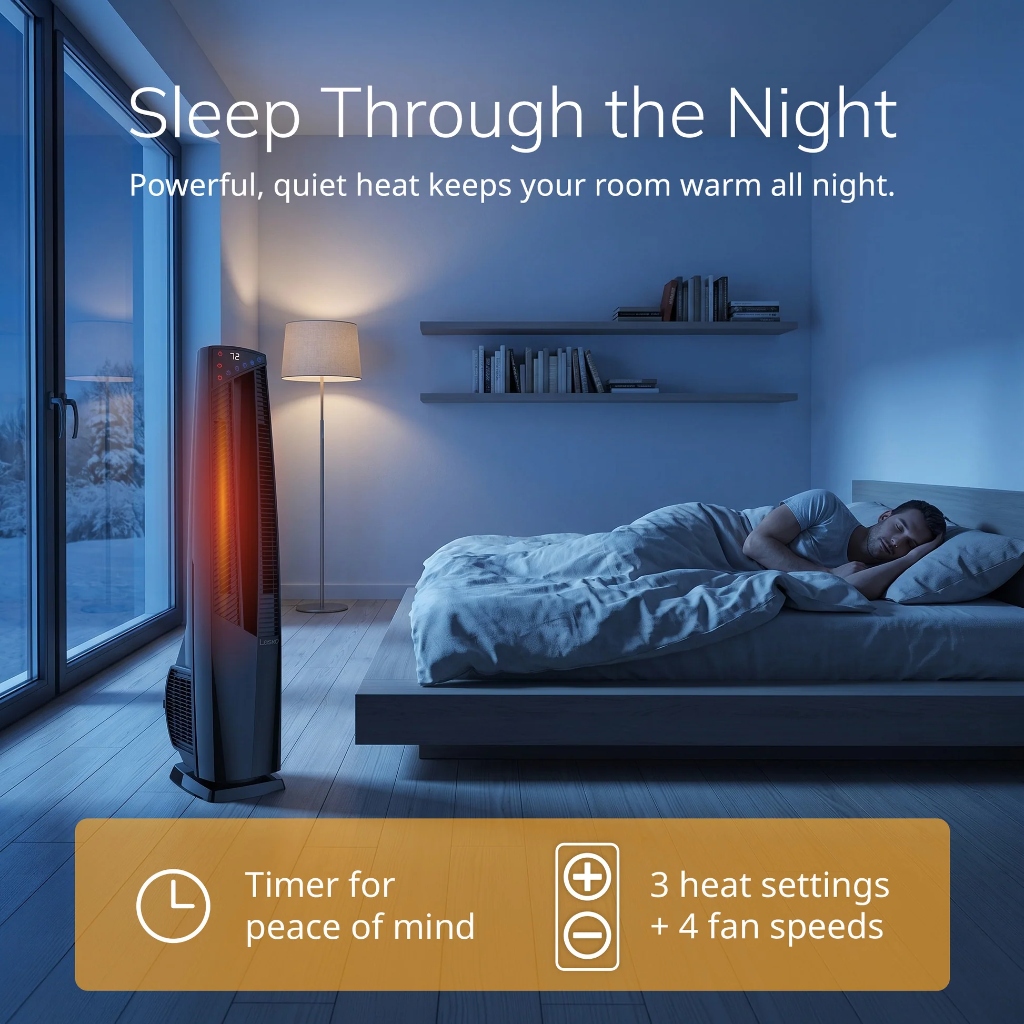
Yes, provided the heater meets current safety certifications (ETL or UL listed) and is used correctly. Look for models equipped with an automatic tip-over switch, overheat thermal shutoff, and an electronic thermostat (like the Lasko DUO Comfort FHV830). Maintain at least 3 feet of clear space around the heater away from bedding and curtains, and plug it directly into a dedicated 120V wall outlet—never an extension cord or power strip.
Why is electricity more expensive per BTU than natural gas?
Electricity is a secondary energy source generated from primary fuels (natural gas, coal, nuclear, renewables) through power plants and transmitted across power grids with thermal and line losses. Natural gas is burned directly inside your home furnace at 80% to 95% efficiency. In the US, electricity averages ~$49 per million BTU compared to ~$15 per million BTU for natural gas.
Our editorial staff evaluates residential heating, cooling, airflow, and indoor air quality appliances against published US engineering and safety standards.
Related Climate & Comfort Guides
Lasko DUO Comfort 38-Inch DC Fan and Heater Review (Model FHV830)
An independent, research-based review of the Lasko DUO Comfort 38" DC fan and space heater (FHV830). Verified manufacturer specs, AutoEco behavior, safety, and operating costs.